Suryax

Premium Header

+91 9636335083

Call Now

info@suryax.com

Email Id

Book Visit
Blue Header
☰

Where to Buy Industrial Land in Jaipur: 7 Things Every Business Owner Must Know

Choosing where to buy industrial land in Jaipur involves more than selecting a familiar area on a map. Your location will affect deliveries, employee journeys, construction planning and the amount of money needed to establish operations. The right address for one business can create unnecessary costs for another.

These seven points explain how to compare locations and identify properties that support your operation rather than merely offer a recognizable address.

[1] Your Business Model Should Determine the Search Area

A manufacturer receiving frequent material deliveries may prioritize transport access and supplier routes. A distribution business may care more about customer coverage and dependable dispatch times. A workshop serving local clients may need convenient customer access and a suitable workforce nearby.

List these requirements before asking where to buy industrial land in Jaipur. Give each a clear priority. When approaching Suryax Group, describe the activity, goods movement and expected operating schedule. This gives the location discussion a practical starting point and helps avoid recommendations based only on availability.

[2] Compare the Complete Route Rather Than Highway Distance

A location described as close to a major road may still involve an inconvenient final approach. Inspect the route your actual delivery vehicle would use, including junctions, turns and the entrance to the plot. Consider restrictions or difficult sections that could affect reliable movement.

Travel the route at a realistic time rather than relying entirely on a weekend visit. Think about how vehicles would enter and leave during busy periods. For a business receiving several deliveries, a small recurring delay can become an operational issue even when the main highway is nearby.

[3] Land Use and Business Permissions Are Location Questions

Before treating an area as suitable, check the status of the particular land and the activities permitted there. Different properties can have different conditions even within the same broad locality. A seller’s description of an industrial corridor does not establish permissions for every parcel.

Have an independent professional review the relevant records and explain requirements for your intended construction and operation. Separate land documents from activity-specific requirements. This helps avoid buying first and discovering later that your planned process needs arrangements the site cannot practically support.

[4] Infrastructure Must Match Your Actual Demand

Roads, power, water and drainage should be assessed at plot level. Ask what exists now, what is planned and what your business must arrange separately. The presence of a utility elsewhere in a development does not establish that your connection will be available on the required terms.

Discuss machinery loads and water demand with technical advisers before finalising the location. Then seek written clarification of capacity, connection costs and timing. When reviewing industrial projects in Jaipur, compare usable infrastructure rather than counting the number of facilities listed in a brochure.

[5] Workforce Access and Surrounding Uses Matter

Employees need a practical way to reach the workplace. Consider commuting options, shift patterns and whether the business will have to provide transport. A lower land price may offer less value if the location creates substantial daily travel difficulties or additional staff transport costs.

Inspect neighbouring activities as well. Noise, dust, traffic and nearby uses can affect your operation’s suitability and working environment. A business requiring cleaner handling conditions may have different location needs from one storing bulky goods. Assess these conditions directly instead of assuming all industrial surroundings are interchangeable.

[6] The Cheapest Area May Not Offer the Lowest Setup Cost

Compare land prices alongside site preparation, construction, utility work and recurring operating costs. Include transport and staff arrangements that differ between locations. If one site requires additional work before use, the lower purchase price may not translate into a lower overall business setup budget.

Create an estimated cost to become operational for each finalist. Record the assumptions behind it and separate confirmed quotations from allowances. Ask for written details of payment dates and included development. This method gives a clearer answer than choosing an area solely because its advertised rates appear lower.

[7] Consider Expansion and the Practical Exit Route

A location should support the next stage of your business as well as the first. Think about additional machinery, storage and vehicle movements. Check whether the selected plot can accommodate a sensible extension, rather than assuming neighbouring land will be available when you need it.

Consider who could use the property if your business relocates. Resale remains uncertain, so plan for an affordable holding period rather than depending on rapid appreciation.

Assess Chomu–Manda Industrial area as a Specific Option

Suryax identifies Surya Industrial Park with the Chomu–Manda area of Jaipur. That makes it a location to examine against your transport, workforce and infrastructure requirements. It does not establish that the area is the best choice for every business or that every available plot suits your operation.

Visit the site, trace delivery routes and confirm available facilities. Compare the findings with alternative locations using the seven points above.

Why Choose Suryax Group for Your Industrial Location Search?

Suryax provides a project website and direct enquiry channels that business owners can use to request information about its industrial options. Reviewing the company’s background can provide context before a discussion. The next step is to request current details relevant to your own location brief.

Ask for an available plot plan, access information, utility details and written commercial terms. Then bring those materials to your advisers for assessment. Combining a direct project discussion with independent checks helps you decide whether a Suryax option belongs on your shortlist without treating general marketing information as a complete property assessment.

Conclusion

The answer to where to buy industrial land in Jaipur depends on your routes, activity, budget and setup schedule. A useful location supports those requirements today and allows a realistic plan for tomorrow. Compare sites on verified facts, including the costs and limitations that may not appear in an advertisement.

For current Suryax options, contact the team with your business requirements and arrange a site visit. Review the specific property before making a commitment. The objective is to select land that works for your operation, rather than buying an address and trying to adapt the business afterwards.

Frequently Asked Questions (FAQs)

[1] Which industrial location in Jaipur is best for my business?

The answer depends on your activity, transport routes, workforce and utility needs. Compare specific properties instead of assuming one area is best for everyone.

[2] Is being near a highway enough?

No. Check the complete route, final approach and plot entrance. The largest vehicle you expect to use should be able to access the site practically.

[3] How can I assess Chomu–Manda?

Visit the proposed property and compare it with your operational brief. Confirm current infrastructure, access and documents for the particular plot under consideration.

[4] Should workforce travel affect my decision?

Yes. Commuting difficulties can influence staffing and transport costs. Consider shift patterns and practical travel arrangements before selecting a location.

[5] What is the next step after shortlisting an area?

Identify available plots, obtain written details and arrange site inspections. Have the relevant documents and technical assumptions reviewed before committing funds.


Industrial Plot for Sale in Jaipur: 9 Smart Ways to Find the Right Property

Searching for an industrial plot for sale in Jaipur can produce plenty of listings without producing a clear decision. Photographs, location descriptions and price quotations often leave important questions unanswered. A property that appears suitable online may not accommodate your vehicles, support your activity or fit your complete setup budget.

These nine approaches help business owners find options, filter unsuitable listings and build a practical shortlist before negotiations begin.

[1] Write a Property Brief Before Searching

Prepare a short document describing your business activity, required land area, proposed building and expected vehicle movement. Include your budget, preferred setup date and any essential utility requirements. Separate needs that cannot change from preferences that could be adjusted if a strong alternative appears.

Share this brief with everyone helping you search. It reduces irrelevant recommendations and creates a consistent basis for comparison. Without it, different sellers may interpret your needs differently, leaving you to compare properties intended for very different operations.

[2] Search Official Project Pages for Detailed Starting Information

Project websites can help identify advertised locations, plot ranges and facilities before arranging visits. Use them to gather questions, not as a substitute for examining the specific property. Record the source and date of each detail so that older information does not quietly become part of your final decision.

For example, Suryax Group provides links to its projects and contact channels. Request confirmation of current availability rather than assuming every advertised option remains on sale. A general project description and a current offer for an identified plot serve different purposes.

[3] Build a Shortlist Around Real Transport Routes

Choose search areas based on your suppliers, customers and delivery pattern. Main road proximity can matter, but the complete journey to the plot is more useful than a broad corridor label. Include travel reliability and the final approach in your assessment.

If heavy vehicles will visit, inspect road widths, turning points and entry arrangements. Ask a suitable professional to test the proposed movement where necessary. A property is not a good logistics fit merely because a map places it close to a highway.

[4] Ask Contacts for Specific Introductions

Business contacts, suppliers and established operators may know of available plots or active developments. Ask for property details and the seller’s contact information rather than relying on a general recommendation. An introduction can help you discover an option, but it does not verify ownership or suitability.

Apply independent checks even to trusted referrals. Their business may have different space, access and utility requirements.

[5] Compare Listings Using the Same Information Sheet

Create a sheet with the location, plot identification, dimensions, quoted rate, total price and included facilities. Add the seller’s name, contact date and any outstanding questions. Use a consistent measurement unit when recording areas and rates.

This approach exposes gaps that polished listings can hide. One seller may quote a base price, while another includes development charges. Until you establish what each quotation covers, a direct price comparison can be misleading. Mark missing details instead of filling them with assumptions.

[6] Visit the Property With an Operational Checklist

On site, check boundaries, frontage, road access, visible levels and the surrounding environment. Imagine where goods would arrive, where vehicles would wait and how production would connect to dispatch. Bring a preliminary layout if you already have one.

Look beyond the entrance and sample facilities. Ask which infrastructure serves the actual plot and what remains to be completed. Take notes and, where permitted, photographs for comparison. A later visit with your architect or engineer can help resolve questions identified during the initial inspection.

[7] Request Documents Before Making a Booking Decision

Ask for documents identifying the parcel, ownership and the basis on which it is being sold. Have a qualified independent professional review them. Ensure that the property shown on site matches the description and area recorded in the relevant paperwork.

Also investigate whether your intended activity and construction are permissible. Requirements depend on the land and operation involved. An industrial label or a seller’s general assurance cannot settle every approval question. Resolve important uncertainties before treating a property as ready for your business.

[8] Test the Full Budget and Setup Timeline

Estimate what it will cost to reach an operational site, including land, professional work, site preparation, construction and utility arrangements. Add financing costs where relevant. A property with a lower purchase price may require more expenditure before it can be used.

Ask for a written payment schedule and possession commitments. Then compare them with your design and business launch plans. If delays would disrupt production or a customer contract, that risk should influence your choice as much as the quoted price.

[9] Compare Finalists Before Negotiating

Bring the strongest options into one final review using the same brief. Identify which property meets your essential requirements with the fewest unresolved assumptions. Keep a clear record of disadvantages as well as strengths, including additional development work and possible limitations on expansion.

Negotiate after you understand the property. Clarify included facilities, charges, payment dates and transaction conditions in writing. A discount cannot compensate for land that fails a fundamental requirement such as usable access or appropriate permitted activity.

Why Choose Suryax Group to Explore Industrial Plots for Sale?

Surya Industrial Park is one Suryax option to investigate in Chomu–Manda, Jaipur. The official page describes industrial plots for business uses. Ask for an identified available plot and assess its dimensions, infrastructure and documents against your brief.

You can review Suryax’s industrial project information and company background before enquiring. Use the discussion to obtain practical details for comparison, including a written quotation and site visit. A useful property conversation should help you understand suitability rather than rely solely on promotional language.

Final Thoughts 

The right industrial plot for sale in Jaipur is easier to identify when every option faces the same checks. Define your operation, gather current details, inspect sites and verify the assumptions behind your budget. These steps help narrow the search without confusing urgency with readiness.

To discuss Suryax options, contact the team with your property brief. Request current availability and the information needed for independent review before deciding whether an available plot deserves a place on your final shortlist.

Frequently Asked Questions

[1] Where should I start my industrial property search?

Start with a written business brief. Use it to search relevant locations, contact project teams and filter listings that do not meet essential requirements.

[2] Can online listings confirm current availability?

Not reliably on their own. Contact the seller for an identified plot, current quotation and availability confirmation before planning a transaction.

[3] Should a referral replace independent checks?

No. Referrals can introduce opportunities, but ownership, permitted use and operational suitability still require appropriate review.

[4] What should I bring to a site visit?

Bring your requirements, vehicle details, budget questions and preliminary layout. Record what you see and identify anything requiring technical clarification.

[5] When should I negotiate the price?

Negotiate once you understand the property, documents and total costs. Otherwise, you may focus on a discount before discovering a more important limitation.

Industrial Land in Jaipur: 7 Key Factors to Compare Before You Invest

Two industrial land listings can show similar prices and still represent very different purchases. One may support your intended activity with manageable development work. Another may involve uncertain access, additional infrastructure spending or documents that need clarification. Comparing only location names and quoted rates can hide these differences.

Before investing in industrial land in Jaipur, decide whether you are buying for your own business, future development or eventual resale. That purpose determines which features matter most.

The seven factors below provide a structured comparison method, helping you assess individual properties and identify questions that need answers before payment.

[1] Match the Location to Your Intended Use

A useful industrial location should suit the business or future occupier you have in mind. Consider where materials originate, where products will travel and how employees will reach the premises. A site can appear well positioned on a map yet create inconvenient journeys for your actual supply chain.

Write down your most frequent transport routes and test them during realistic operating hours. Include the final approach to the property. When reviewing Suryax Group’s real estate options, describe the activity and routes involved so that location discussions stay connected to your business needs.

[2] Examine Ownership and Permitted Use

Establish who owns the land and who has authority to sell it. Have the property description, boundaries and supporting records reviewed by an independent professional. Documents should identify the same parcel you inspected. Any mismatch in ownership details, area or access deserves clarification before you proceed.

Separately check whether your proposed activity and construction are permitted. A property described as industrial does not automatically establish that every manufacturing process is suitable there. Ask which approvals apply to the land and which your particular operation would need. Obtain advice relevant to the property’s location and classification.

[3] Compare the Infrastructure You Can Actually Use

Power, water, drainage and roads affect how quickly a business can begin operating. Distinguish facilities already available from facilities planned for later. A project description may list infrastructure without establishing the capacity, connection arrangements or completion status relevant to your selected plot.

Request written details of utility capacity, connection costs and responsibility for maintenance. Consider whether your operation requires more than the standard provision. The relevant question is not simply whether electricity is mentioned, but whether the connection can meet your machinery’s requirements within your intended setup schedule.

[4] Assess Dimensions and Physical Site Conditions

Total land area is an incomplete measure of usefulness. Frontage, shape, levels and entry points influence the layout and cost of development. A property may need levelling, boundary work or other preparation before construction. Such work can change both the budget and the time needed to become operational.

Visit the site with a layout professional where possible. Compare the dimensions with your intended building, loading area and vehicle circulation. Review visible drainage conditions and ask about the site’s history. If a technical concern appears, investigate it rather than assuming that later construction will solve the problem inexpensively.

[5] Calculate the Complete Acquisition and Development Cost

A low headline rate does not necessarily mean a lower total investment. Compare the land price together with applicable transaction charges, development costs, professional fees and utility connections. If construction will follow, include its estimated cost and the funding required before the property can generate business income.

Use one comparison sheet for every shortlisted option. Separate confirmed amounts from estimates and unresolved charges. Ask for payment milestones and cancellation conditions in writing. Also consider the cost of borrowing and the effect on working capital, particularly if the property will remain unused during a development period.

[6] Understand the Development and Possession Timeline

An attractive property can become unsuitable if it is not usable when your business needs it. Clarify when possession is available, what work remains and which commitments are documented. Avoid assuming that possession, construction readiness and permission to commence your activity all mean the same thing.

Build a schedule covering document review, payment, possession, design, approvals where applicable, construction and utilities. Identify dependencies that could delay operations. If an important milestone is uncertain, consider whether your business can absorb the delay or needs an alternative location available sooner.

[7] Evaluate Future Demand and Your Exit Options

If investment value is important, think about who might buy or occupy the property later. Practical dimensions, usable access and appropriate infrastructure can influence that audience. However, a growing corridor or a nearby development does not establish a guaranteed resale price or a fixed annual return.

Ask about comparable properties and distinguish advertised asking prices from completed transactions. Consider how long you can hold the asset without income. A realistic exit plan includes the possibility that finding a buyer takes longer than expected, especially for a plot designed around a highly specialized business activity.

Why Choose Suryax Group When Comparing Industrial Land in Jaipur?

Suryax’s Surya Industrial Park information describes a development at Chomu–Manda with industrial plot options. Use that project information to frame questions about available parcels, infrastructure and intended business use. Confirm the current details for the exact property being offered.

For a wider comparison, review the company’s industrial project information and company background. A useful enquiry should request a dimensioned plot plan, written pricing and supporting documentation. Assess those materials using the same standards you apply to every other shortlisted property.

Final Thoughts

Create a simple scorecard using the seven factors above. Give more importance to requirements that your operation cannot compromise on, such as permitted activity or vehicle access. Mark missing evidence clearly. An unresolved ownership question should not disappear because a property scores well on price or appearance.

Before committing, have the relevant documents and technical assumptions reviewed. If a Suryax option fits your brief, contact the team for a site visit and current written details. Choose industrial land in Jaipur on the strength of verified suitability and an affordable plan, rather than promotional expectations alone.

Frequently Asked Questions

[1] What should I compare first when buying industrial land?

Start with intended use, ownership and access. These establish whether a property deserves detailed technical and financial assessment before you spend time negotiating.

[2] Are industrial plots and ready factories comparable?

They require different budgets. A plot may need construction and utility work, while a ready factory must be checked for building suitability and condition.

[3] How should I compare quoted land prices?

Use the same measurement unit and include additional charges. Compare total acquisition and development costs, not only the advertised rate.

[4] Does a developing location guarantee appreciation?

No. Future value depends on demand, supply and the individual property. Treat forecasts as uncertain and plan for a longer holding period if necessary.

[5] Which details should be confirmed in writing?

Confirm the plot identity, dimensions, pricing, included facilities, payment schedule, possession commitments and cancellation terms. Obtain independent review of documents relevant to the transaction.

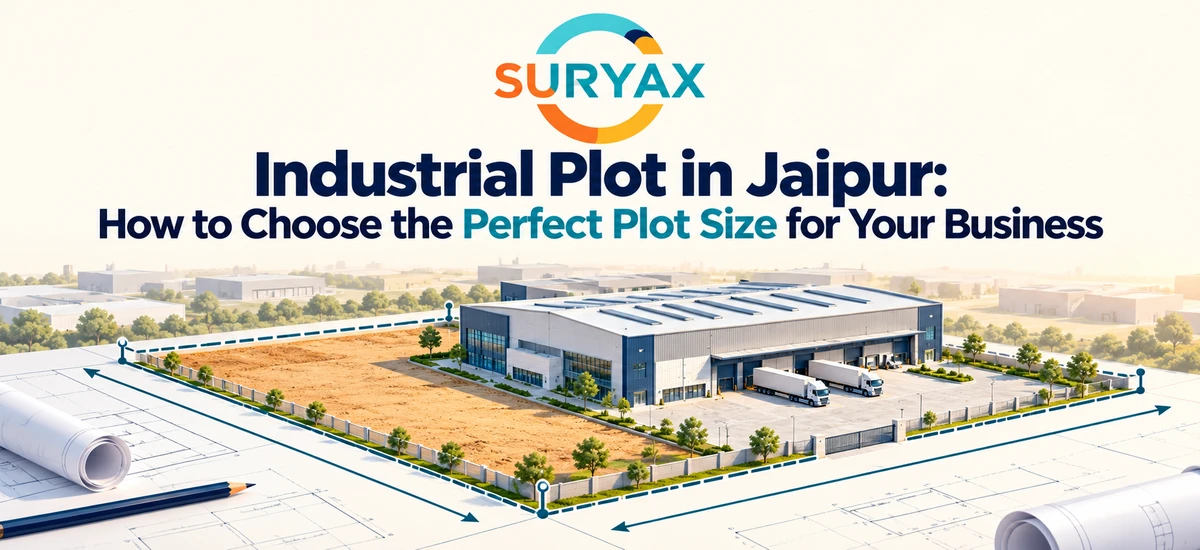
Industrial Plot in Jaipur: How to Choose the Perfect Plot Size for Your Business ?

Buying an industrial plot in Jaipur starts with a practical question: how much land will your business actually use? A plot that looks affordable can become restrictive when machinery, loading vehicles, storage and employee facilities compete for space. An oversized purchase can also tie up money needed for equipment and working capital.

The right size comes from planning your operation before comparing properties. Instead of choosing an area because another company bought something similar, map your own production process, vehicle movement and expansion needs. This guide explains how to turn those requirements into a realistic land brief and a more useful property shortlist.

Start Your Business Activity With Industrial Plot in Jaipur

A packaging unit, engineering workshop and distribution warehouse use land differently. Manufacturing may need separate production, raw material and finished goods areas. A warehouse may need more space for loading, circulation and vehicle parking. An assembly operation might require cleaner separation between incoming components and completed products.

Write down your daily activities before approaching a seller. Include dispatch frequency, expected staff numbers and the largest vehicles visiting the premises. When exploring Suryax Group’s property options, share this operational brief rather than asking only for the smallest available industrial plot.

Calculate Space From the Inside Out

Begin with the equipment and workstations that must fit inside your building. Measure machinery footprints and allow for operating clearance, maintenance access and safe movement. Add space for materials waiting between production stages. Equipment dimensions alone do not represent the full area required to operate it.

Next, consider storage, offices, staff facilities and utilities. Depending on your activity, you may also need dedicated areas for packaging, inspection or waste handling. An architect or industrial layout specialist can combine these requirements into a preliminary plan before you commit to a particular plot.

Separate Industrial Plot Area From Usable Building Space

The entire plot will not necessarily be available for construction. Applicable setbacks, access requirements and other development conditions can affect the building footprint. These depend on the specific property and relevant rules, so avoid using a universal construction percentage when estimating land requirements.

For illustration, imagine your operation requires a building footprint of 600 square meters. If professional review establishes that a particular site’s permissible footprint is 60% of its area, the starting calculation would be 600 divided by 0.60, or 1,000 square meters. This is a hypothetical example, not a Jaipur planning rule or project specification.

Check Industrial Plot Shape and Frontage

Two plots with identical areas can support very different layouts. A narrow frontage may restrict gate placement and vehicle entry. An irregular boundary can create awkward spaces that are difficult to use. A more regular shape may simplify planning, but suitability still depends on your building and circulation requirements.

Request dimensions for every boundary, not just total area. Mark the entrance, proposed building and loading zone on a rough plan. Compare the usable arrangement with the purchase price. A slightly larger plot can sometimes offer less practical space than a smaller plot with better dimensions.

Give Trucks and Loading Their Own Space

An industrial property must work beyond the factory floor. Delivery vehicles need room to enter, turn, load and leave without blocking other activities. Check the largest vehicle expected at your premises and ask a qualified designer to test its movement through the proposed layout.

Inspect the approach road as well as internal space. A wide road inside a development does not resolve a difficult turn or restricted approach outside it. When comparing industrial projects in Jaipur, assess the complete route between the main road and your proposed loading point.

Allow for Utilities and Future Expansion

Power equipment, water storage and other service areas may need land outside your main production space. Their requirements vary by business. Confirm your actual demand with technical professionals and identify where equipment can be located without interrupting access or limiting a future building extension.

Expansion space should follow a credible business plan. Consider which additional production line or storage area you may need, when it might become necessary and how it would connect to the existing operation. Buying extra land without a purpose can reduce the cash available to establish your business successfully.

Compare the Total Cost of Different Sizes

The price per square yard is only one part of the decision. A larger boundary may mean higher expenditure on fencing, security, landscaping and site preparation. Additional land can also affect borrowing requirements and the amount of money available for construction and machinery.

Prepare separate budgets for purchase, development and business launch. Ask for a written quotation showing included items, additional charges and payment dates. Compare alternatives against the same operational layout. The most suitable industrial plot in Jaipur is the one that supports your business within an affordable overall plan.

Why Choose Suryax Group for Your Industrial Plot Size Search?

Surya Industrial Park is presented by Suryax as a Chomu–Manda, Jaipur development with plot options from 250 to 10,000 square yards. That advertised range provides a starting point for discussing different land requirements, subject to current availability and individual plot details.

Bring your layout brief when enquiring. Ask which dimensions and locations can accommodate it, and review the relevant documents independently. Read about Suryax Group for company context, then assess the specific plot rather than treating general project information as proof of operational suitability.

Make the Final Decision With a Layout

Before booking, have your preferred option checked against machinery placement, building requirements, service areas and vehicle circulation. Confirm boundaries and access on site. If the layout works only by removing necessary storage or blocking expansion, reconsider the plot even if its quoted rate looks attractive.

To discuss available options, contact Suryax Group with your business activity, proposed built space and budget. A clear brief makes the conversation more productive and helps you compare plots using practical requirements rather than area alone.

Frequently Asked Questions

[1] What is the ideal industrial plot size for a small business?

There is no single ideal size. Calculate production, storage, vehicle movement and service requirements first, then check what the specific plot can accommodate under applicable conditions.

[2] Is a larger plot always better?

No. Additional land is useful when it supports a realistic expansion plan. Otherwise, it can increase costs and reduce money available for operations.

[3] Why do frontage and shape matter?

They affect entrances, building arrangement and loading access. Total area alone cannot show whether your proposed operation will fit comfortably.

[4] Should I finalize machinery before buying land?

At least prepare an equipment schedule and preliminary layout. Major changes in machinery can change the building footprint, utility demand and required circulation space.

[5] Can I rely on the seller’s suggested plot size?

Use it as an initial option. Have your own designer test the layout and obtain independent advice on documents and applicable development requirements before committing.